
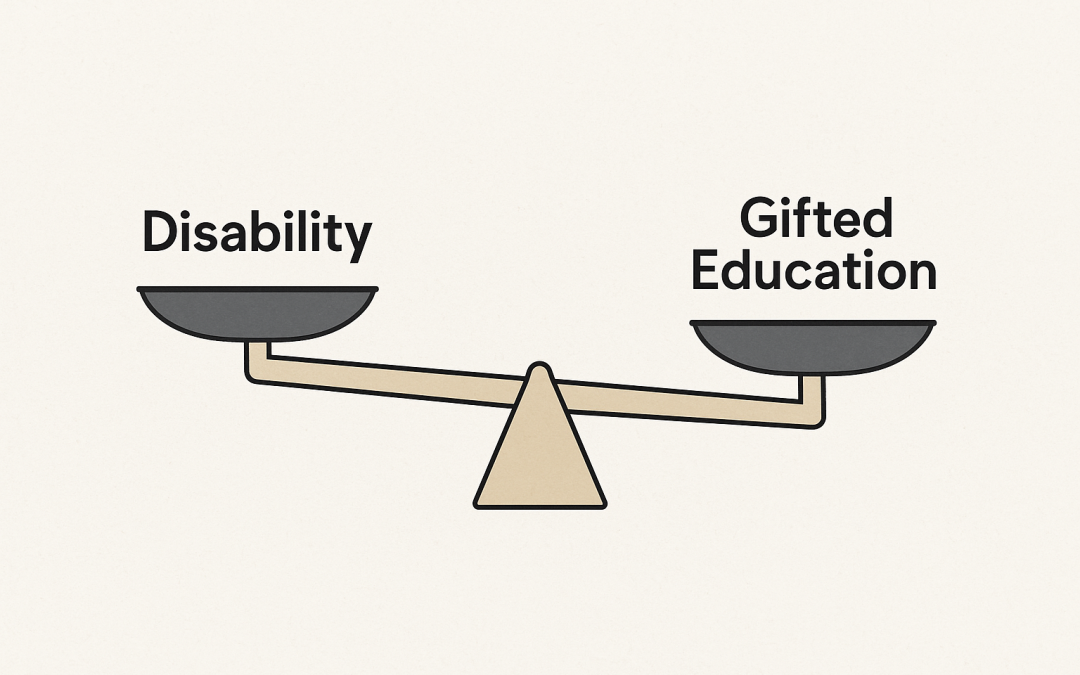
2e education is one of my particular research interests but tracking them is tricky because they straddle two systems: gifted education and special education.
Here’s a quick tour of what data exists in the U.S., along with some caveats (and a pinch of humor so it’s not all doom and gloom):
🎓 1. Federal Data Sources (IDEA and OCR)
- IDEA (Individuals with Disabilities Education Act) collects data on students with disabilities but does not separately track giftedness.
- The Civil Rights Data Collection (CRDC) from the Office for Civil Rights reports on participation in gifted and talented programs and disability status, but doesn’t officially cross-tabulate the two.
- Translation: The government sort of knows who’s in the gifted bucket and who’s in the disability bucket, but it doesn’t systematically note who’s in both.
- You can sometimes infer overlap by combining data sets (if you like your statistics extra crunchy).
📊 2. State-Level Data (Varies Wildly)
- Some states (like Colorado, Texas, and California) collect better data on gifted students who also have IEPs or 504 plans.
- A few states publish annual reports on gifted education with mention of 2e students, but it’s rarely detailed.
- Some districts track 2e identification locally, often as part of gifted identification reports.
- No national uniform standard exists, so it’s a glorious patchwork quilt of data (with many missing squares).
📚 3. Research and Surveys
- National Center for Research on Gifted Education (NCRGE) conducts studies estimating 2e prevalence. One example:
- Their work suggests many 2e students are underidentified—meaning they’re often overlooked in gifted programs.
- NAGC (National Association for Gifted Children) publishes reports and position papers with some aggregate estimates (but not official counts).
- Academic researchers (e.g., Baum, Reis, Renzulli) have published survey-based estimates indicating 2e prevalence rates of 3–5% of the total student population (though these are estimates, not hard counts).
📈 4. Prevalence Estimates (Unofficial but Often Cited)
- No single federal number exists.
- Estimates of 2e prevalence vary but are typically cited as 300,000–500,000 students nationwide, depending on definitions.
- Because the identification criteria differ by state/district, the numbers are likely undercounts.
🔍 How You Can Access Data
- OCR Data Explorer (CRDC): ocrdata.ed.gov
- Download datasets with disability and gifted enrollment by district.
- State Education Department websites:
- Look for reports on gifted education or child find reports under IDEA.
- NCRGE publications:
- NAGC resources: